
Early Warning
The Hormuz Shock: How a Closed Strait Is Redrawing the World’s Energy Map
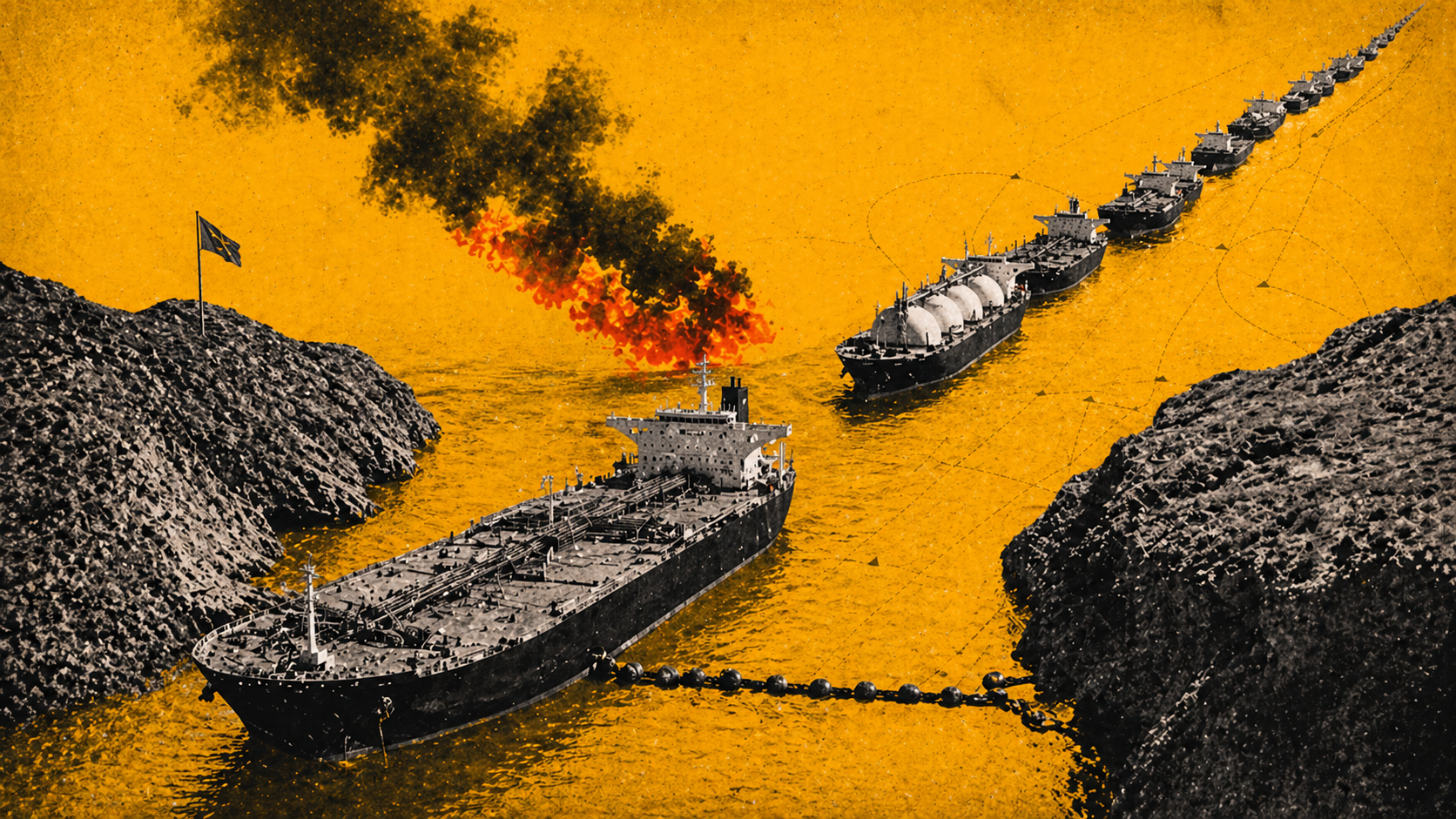
On February 28, 2026, the detonation of the first confirmed sea mine in the navigable shipping lane of the Strait of Hormuz set in motion the largest supply disruption in the recorded history of global oil markets. The 21-mile-wide chokepoint — through which approximately 21 million barrels of petroleum and the equivalent of nearly 20 percent of the world’s entire LNG exports transited daily — was effectively closed to commercial shipping within weeks, as the Islamic Revolutionary Guard Corps launched at least 21 confirmed attacks on merchant vessels, and maritime traffic plummeted by over 70 percent before falling to absolute zero by late March. The International Energy Agency categorized the shock as historically unprecedented, and the numbers validate that characterization: global crude oil prices surged by as much as 57 percent within the first weeks of sustained disruption, retail diesel prices in Sydney breached $3.22 per litre, and Australia’s national consumption cover for jet fuel collapsed to a critically exposed 21 days, with diesel cover at 26 days and petrol at 28 days. Approximately 30 percent of the global fertilizer trade — transiting the same waters — was simultaneously blocked, threatening harvest yields across sub-Saharan Africa where households already allocate nearly 50 percent of income to food.
These are not the consequences of a localized military engagement. They are the logical output of a global energy architecture that concentrated an estimated 25 percent of all seaborne petroleum trade, 20 percent of global LNG exports, and vast flows of industrial metals through a single maritime corridor — a vulnerability that decades of market-driven optimization consistently chose to treat as manageable rather than existential. What the 2026 crisis exposed, with stark and irreversible clarity, is that the era of petro-centric globalization has reached a structural limit. But what it also triggered is equally significant: an irreversible acceleration of the global pivot toward sovereign, technology-anchored energy systems — a pivot that is rapidly rewriting the roles of the world’s established energy players.
This analysis examines the cascading effects of the Hormuz shock across three interlocking dimensions. First, it traces the immediate and structural disruption to global fossil fuel markets. Second, it analyzes how the energy security crisis has acted as an accelerant for the renewable energy transition and the emergence of what strategic analysts now term the ‘electrostate’ model of geopolitical power. Third, it evaluates the profound inversion this transition is engineering in the traditional hierarchy of energy importers and exporters — one in which China, historically the world’s largest crude oil importer with a dependency ratio of 72.4 percent as recently as 2024, is systematically repositioning itself as the world’s dominant clean energy exporter, while fossil fuel exporters like Australia — which generated $238.7 billion in resource export earnings in 2022–23 — face a structural collapse of their traditional revenue base and a growing dependency on imported clean energy technology. All scenarios quantified in this analysis and all outcome trajectories modeled by Obex Analytica are accessible in full through the interactive dashboard attached at the close of this report.
The Chokepoint: Anatomy of an Energy System Failure
The Strait of Hormuz has long been identified as the critical vulnerability of the global fossil fuel system, but its abstract status as a risk factor was never translated into structural mitigation at the system level. The 2026 closure converted that abstraction into operational reality. With three narrow shipping lanes — two outbound, one inbound — and a maximum Very Large Crude Carrier draft of 15.5 meters, the strait’s physical geometry offered no redundancy. When IRGC forces mined the navigable channels and imposed a formal closure on vessels associated with the United States, Israel, and allied nations, the bypass architecture that existed — overland pipeline capacity rated at between 3.5 and 5.5 million barrels per day — could offset only a fraction of the 20 to 21 million barrels stranded daily. Spare production capacity held by Saudi Arabia, running at over four million barrels per day in late 2025, was rendered entirely inaccessible, eliminating the geopolitical buffer that importing nations had relied upon for decades.
The disruption extended well beyond crude oil. Qatar and the UAE together account for nearly 20 percent of global LNG exports, and both were effectively frozen out of global spot markets, placing intense upward pressure on Asian and European gas prices and forcing governments to mandate demand reductions across industrial and residential sectors. Simultaneously, the same waterway carried roughly 30 percent of the global fertilizer trade — methanol, urea, and sulfur — whose blockage threatened to cascade into food production crises across developing economies by the 2026 harvest season. Aluminum from Bahrain and the UAE, a critical input for the solar panels and power lines of the very clean energy transition meant to replace fossil dependency, was similarly constrained, granting alternative suppliers sudden and immense pricing leverage.
Source: Obex Analytica forecast.
| Commodity Category | Global Trade Share Disrupted | Primary Downstream Impact |
|---|---|---|
| Crude Oil | ~25% of global seaborne trade | Transport, manufacturing, diesel logistics, +57% price surge |
| LNG | ~20% of global exports (Qatar + UAE) | Asian/European power generation, industrial heating, spot inflation |
| Fertilizers | ~30% of global transit trade | Food security, harvest yields, inflation in African economies |
| Industrial Metals (Aluminum) | Significant GCC regional output | Renewable infrastructure, EVs, aerospace, power line construction |
Australia’s exposure to this shock illustrated precisely why geographic proximity to Asia does not equate to supply chain resilience. As a nation that imports between 80 and 90 percent of its daily refined fuel requirements — despite exporting 96 percent of its own crude oil production — Australia sits two steps upstream from the disruption. Its refined petroleum does not arrive from the Persian Gulf directly; it arrives from South Korean and Singaporean mega-refineries, which themselves are overwhelmingly dependent on Middle Eastern feedstock. In 2024 alone, Australia spent $9.18 billion on refined petroleum imports from South Korea and $6.44 billion from Singapore. When those refineries faced constrained crude supply and prioritized domestic mandates, Australia — with the lowest strategic petroleum reserves of any IEA member nation at approximately 49 days of net import coverage — found itself effectively starved of supply. This layered vulnerability, this ‘two-steps-upstream’ exposure, is the defining structural fragility of the petro-globalization model.
The Accelerant: Fear as a Driver of the Clean Energy Pivot
Historical precedent established that oil shocks typically produce short-term stabilization responses — subsidy programs, strategic reserve releases, emergency diplomatic negotiations — followed by a return to structural dependence once the immediate pressure subsides. The 2026 crisis departed from that pattern. The magnitude and speed of the disruption, combined with the now-demonstrable inadequacy of the fossil-supply buffer, catalyzed a qualitatively different response: an acceleration of sovereign energy infrastructure that deliberately removes the dependence on imported combustible fuels.
The empirical data from March 2026 — the first full month of the Hormuz closure — documented a result that confounded consensus forecasts. Global power generation from fossil fuels fell by one percent year-on-year, even as a major supply shock was actively unfolding. This occurred because the record global build-out of solar and wind capacity throughout 2024 and 2025 had structurally reduced the underlying demand for thermal generation. In regions where near-real-time generation data was available, solar output grew by 14 percent and wind by eight percent against the same month a year prior, while gas-fired generation contracted by four percent and coal-fired generation fell by 3.5 percent. Seaborne coal transport volumes simultaneously fell to their lowest levels since 2021. Rather than reverting to coal — as occurred during the 2022 European energy crisis — the economies most advanced in renewable deployment used existing clean capacity as an effective geopolitical buffer.
Source: Obex Analytica forecast.
The policy response hardened this structural trajectory. In Europe, where energy prices had already run at roughly double the levels of the United States and 50 percent above China for years, the shock forced a strategic reckoning. Nations that had previously diversified aggressively — Denmark’s offshore wind links to Germany via HVDC cable, Spain’s domestic green hydrogen buildout for industrial feedstocks — demonstrated measurable insulation from the worst effects of the price surge. The lesson was absorbed immediately at the policy level: the most durable defense against maritime chokepoint vulnerability is an energy system architecturally incapable of being disrupted by maritime chokepoints.
The nuclear dimension of this pivot requires particular attention. At the March 2026 Nuclear Energy Summit in Paris, the European Commission President formally characterized the continent’s prior retreat from nuclear power as a ‘strategic mistake,’ announcing state-backed investment frameworks to reinstate nuclear as a dispatchable, low-emission complement to variable renewables. Nuclear’s share in the European energy mix had fallen from approximately one-third in the 1990s to just 15 percent by 2026; the political and economic consensus for its revival had, until the Hormuz crisis, remained contested. Asia amplified this momentum: South Korea moved to increase nuclear output, Taiwan formally debated restarting mothballed reactors, and emerging economies across sub-Saharan Africa — Kenya, Rwanda, South Africa — accelerated long-term reactor planning, recognizing that industrialization on volatile fossil fuel imports is existentially unsustainable.
China’s Manufactured Advantage: The Anatomy of an Electrostate
No nation has benefited more from the structural realignment triggered by the Hormuz closure than the People’s Republic of China — and no nation was more strategically prepared for it. The paradox is that China enters this new order as a nation that, as recently as 2024, imported a record 11.1 million barrels of crude oil per day, representing 23 percent of all global crude imports and sustaining a dependency ratio of 71.9 percent. By any conventional measure, China should be among the most exposed nations to a Middle Eastern supply disruption. Instead, it has positioned itself as the architect and primary beneficiary of the world that emerges from that disruption.
The mechanism of this positioning is the deliberate, state-directed construction of industrial dominance across the entire clean energy value chain. In 2025, China’s domestic investments in clean energy reached 7.2 trillion yuan — approximately one trillion US dollars — roughly four times the capital still allocated to fossil fuel extraction. The clean technology sector contributed more than 10 percent of China’s total GDP in 2024, anchored by what President Xi Jinping has termed the ‘new trio’: solar photovoltaics, lithium-ion batteries, and electric vehicles. In the first half of 2025 alone, China added 210 GW of solar capacity and 50 GW of wind — a pace without precedent in the history of energy infrastructure deployment. For the full year 2025, China added an estimated 300 GW of solar and 100 GW of wind, the largest single-year renewable energy build in any country’s recorded history.
Source: Obex Analytica forecast.
The strategic leverage embedded in this scale of deployment is compounded by China’s control of the upstream mineral inputs that the entire global energy transition depends upon. China currently processes approximately 60 percent of the world’s lithium and cobalt, refines more than 90 percent of the rare earth elements critical for the specialized magnets in wind turbine generators and EV motors, and produces approximately 60 percent of the world’s aluminum — the metal fundamental to power lines, turbine blades, drone airframes, and solar module structures. With Middle Eastern aluminum exports from Bahrain and the UAE simultaneously constrained by the Hormuz blockade, China’s leverage as the industrial supplier of last resort was exponentially amplified at precisely the moment the world needed it most.
China’s export reach extends beyond generation components to the macro-architecture of electrified economies. In 2025, China exported a record 64.6 billion yuan — approximately $9.3 billion — worth of power transformers, a 36 percent increase year-on-year, as global grid upgrade demand surged against a chronic 30 percent supply shortage in the United States alone. Chinese state-owned firms are now supplying the software for grid operators, building and operating entire regional electricity networks in South America and Southern Europe. By exporting not only the generation hardware — solar panels, wind turbines — but the transmission infrastructure — HVDC cables, transformers — and the operational software, China is embedding its technological standards and economic dependency deep within the critical energy architectures of foreign nations. On the nuclear dimension, the Hualong One reactor platform has become the world’s most widely deployed third-generation pressurized water reactor, with successful overseas deliveries in Pakistan generating over 48 billion kilowatt-hours and saving nearly 15 million tons of coal consumption annually — a proven track record of on-time delivery that Western and Russian nuclear vendors have been unable to match.
| Clean Energy Sector | China’s Global Market Position | Strategic Implication |
|---|---|---|
| Solar Photovoltaics | Modules priced $0.09–$0.11/W; ~99% of Australia’s installed solar imported from China | Price-based lock-in of importing nations; replaces oil revenues with tech dependency |
| Lithium-ion Batteries | ~60% global lithium & cobalt processing; majority of battery cell manufacturing | Controls cost and availability of grid storage for renewable transition |
| Power Transformers | $9.3B in exports in 2025 (+36% YoY); 30% US supply gap persists | Embeds Chinese grid standards; controls timeline of grid modernization |
| Nuclear (Hualong One) | World’s most deployed Gen III reactor; exports to Pakistan, Argentina, Algeria | Long-term strategic partnership; fuel & technology dependency for 60-year asset life |
| Rare Earths & Aluminum | >90% rare earth refining; ~60% aluminum production | Chokehold on inputs to wind turbines, EVs, and power lines globally |
The Fossil Exporter Paradox: From Revenue Engine to Import Dependency
The inversion that the Hormuz crisis has accelerated is perhaps most starkly illustrated in the case of Australia. For decades, Australia has defined its macroeconomic identity by the extraordinary scale of its resource exports: in 2022–23, total energy export earnings reached $238.7 billion, the nation exported 9,606 petajoules of black coal — of which 88 percent went directly to foreign markets — along with 4,541 petajoules of LNG, cementing its status as the world’s second-largest coal exporter and third-largest LNG exporter. Simultaneously and paradoxically, the country imports between 80 and 90 percent of its daily refined petroleum requirements, having dismantled its domestic refining capacity from eight operational refineries to just two government-underwritten legacy facilities — Viva Energy’s Geelong plant and Ampol’s Lytton facility — through a cascade of closures driven by the scale economics of Asian mega-refineries.
This paradox — exporting enormous volumes of raw energy while importing the processed fuel that powers domestic transport and logistics — becomes structurally untenable as both legs of it deteriorate simultaneously. On the export side, Treasury modeling projects that Australian fossil fuel export revenues, estimated at approximately $130 billion in 2025, will decline by over $60 billion by 2030 and plunge below $30 billion by 2050, driven by the inexorable decommissioning of coal-fired power stations across Australia’s primary trading partners in Asia and the structural transition away from LNG as the region’s transition fuel. Coal output is projected to fall between 42 and 51 percent by 2035. LNG production is expected to contract by up to 27 percent over the same period.
Source: Obex Analytica forecast.
| Export Category | Est. Value 2025 | Projected Value 2035 | Projected Value 2050 | Trajectory |
|---|---|---|---|---|
| Fossil Fuels (Coal & LNG) | ~$130 Billion | ~$70–$80 Billion | <$30 Billion | Structural decline — global decarbonization mandates |
| Green Commodities (Critical Minerals & Green Metals) | ~$30 Billion | ~$80 Billion | $109–$178 Billion | Growth contingent on onshore processing via renewable energy |
The import side of Australia’s structural exposure is equally deteriorating. The aggressive domestic deployment of renewable energy infrastructure — Australia commissioned 4.9 GWh of grid-scale batteries in 2025, matching the output of the entire preceding eight years combined, and has 74 storage projects representing 13.3 GW of power capacity in the pipeline — is critically dependent on imported technology. Australia manufactures approximately one percent of the solar panels installed domestically, with the remaining 99 percent sourced overwhelmingly from Chinese manufacturers whose modules, priced at between $0.09 and $0.11 per watt, are structurally incompatible with domestic replication at competitive cost. For wind energy, the situation is comparable: Australia currently imports nearly all of its wind infrastructure despite forecasts indicating the need for 86 GW of new wind capacity — roughly 14,000 onshore turbines — by 2035. The country is, in effect, replacing its dependence on imported fossil-fuel-derived refined petroleum with an equally concentrated dependence on imported Chinese clean energy hardware.
The strategic logic of this trajectory, extended to its structural conclusion, describes the precise inversion of the petro-globalization hierarchy. Australia, a nation that for four decades exported the raw fuel that powered Asia’s industrial growth and implicitly funded China’s economic miracle, is transitioning into a net importer of the technologies that China has used the revenues of that fuel to develop and industrialize at scale. The former fossil fuel exporter becomes a consumer of the electrostate’s manufactured output. The former buyer of Australian coal and LNG becomes the seller of the infrastructure Australia needs to replace the revenue that coal and LNG once generated. Traditional trade flows do not merely slow — they reverse direction, and the terms of dependency shift with them.
Source: Obex Analytica forecast.
The broader pattern applies beyond Australia. Traditional fossil fuel exporting nations that have not invested at sufficient scale in downstream processing or clean technology manufacturing face a comparable structural exposure: revenue from commodity exports declining as demand contracts, and capital expenditure for energy system transformation flowing outward to the small number of nations that control the industrial base of the energy transition. The geopolitical leverage once derived from a subterranean resource — the oil and gas that could be withheld, priced, or weaponized through a maritime chokepoint — transfers to the nation that controls the manufactured hardware and the processed minerals without which the clean energy transition cannot physically occur. The Strait of Hormuz, for thirty years the defining chokepoint of geopolitical energy power, is being replaced by a different kind of chokepoint — one built of supply chains in silicon, lithium, and rare earth magnets, and one that runs not through a narrow nautical passage but through the industrial districts of Shandong, Jiangxi, and Guangdong.
Interactive Analytical Dashboard
All scenarios, outcome trajectories, and quantitative projections referenced in this analysis are available in full through the Obex Analytica interactive dashboard attached at the end of this report. The dashboard provides access to modeled energy revenue scenarios for Australia and comparable fossil fuel exporters under three disruption timelines (30-day, 90-day, and sustained closure), China’s clean energy export market share projections through 2035, global renewable acceleration curves by region, commodity price trajectory models for crude oil, LNG, aluminum, and rare earths, and bilateral trade flow inversions between legacy fossil exporters and the electrostate tier. Scenario parameters are fully adjustable by the client analyst.




Japan’s Monetary Intervention and the Cost of Imported Cars

Iran’s Oil Infrastructure Under Blokade: Production Decline And Recovery Constraints

The Hormuz Shock: How a Closed Strait Is Redrawing the World’s Energy Map

A Commodity Forecast for Middle Eastern Economies Under El Niño

Fragile Regional Security: Targeting Strategic Infrastructure in the Gulf States
-

 Dynamics Monitor6 months ago
Beyond Sanctions: Evaluating Iran’s Economic Adaptation and the Viability of a 2026 Naval Blockade
-

 Policy Compass6 months ago
These \’90s fashion trends are making a comeback in 2017
-

 Policy Compass6 months ago
These \’90s fashion trends are making a comeback in 2017
-

 Future Radar6 months ago
The final 6 \’Game of Thrones\’ episodes might feel like a full season