
Early Warning
A Commodity Forecast for Middle Eastern Economies Under El Niño
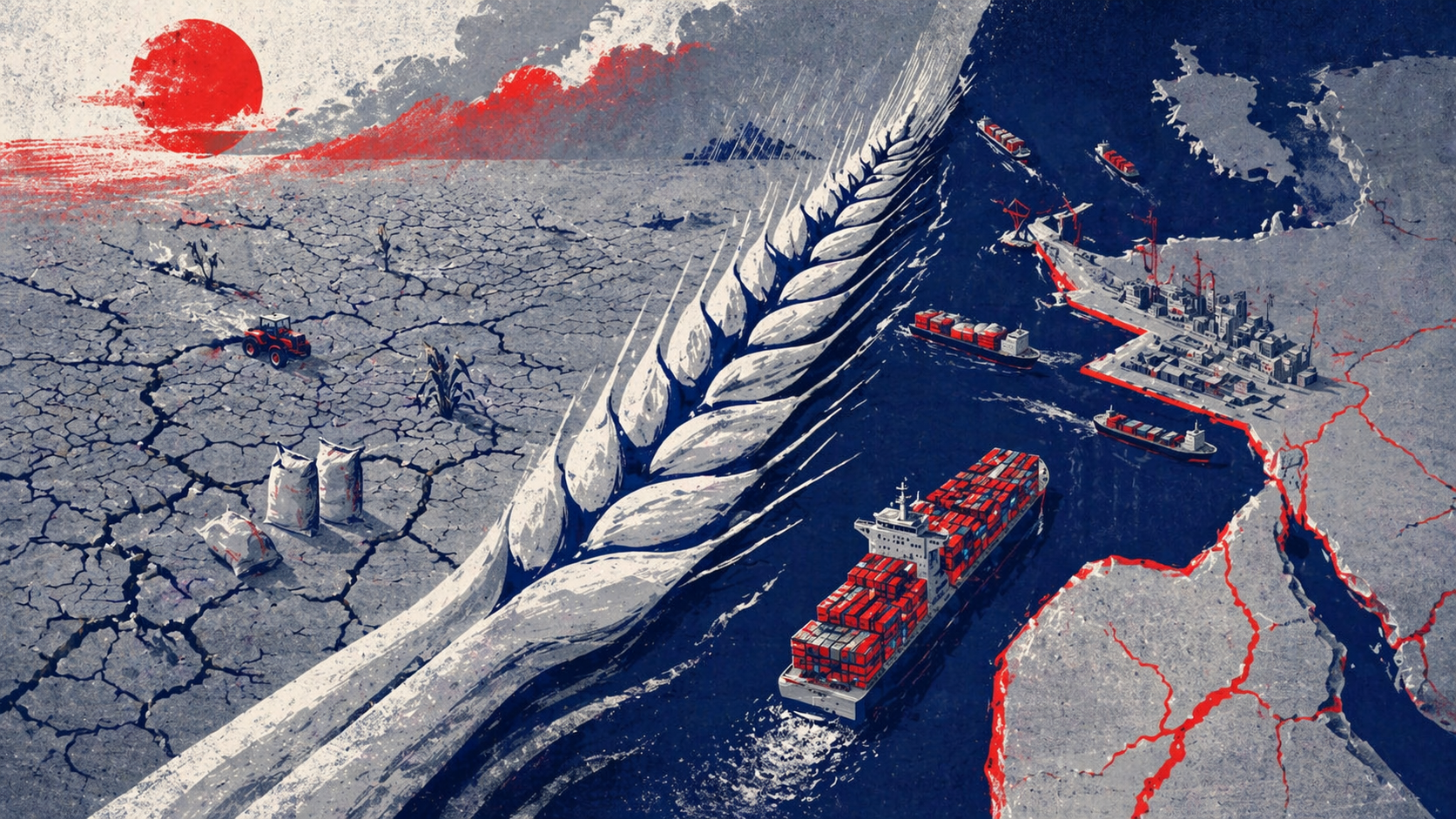
As 2026 advances into its second quarter, the global commodity complex is already navigating its most disruptive configuration since the pandemic-era supply collapse. Brent crude averaged $103.7 per barrel in March 2026, against a 2025 full-year average of $69.0 — a 50 percent premium sustained not by demand recovery but by a geopolitical supply rupture of historic proportions. European natural gas benchmarks on the TTF hub surged to $17.9 per million British thermal units, while aluminium on the London Metal Exchange reached $3,373 per tonne and copper settled at $12,529 per tonne. Wheat for hard red winter delivery was trading at $275.9 per metric tonne, maize at $212.7 per tonne, and palm oil at $1,103 per tonne. These are not the prices of a market in equilibrium.
They are the prices of a market absorbing, simultaneously, the near-complete closure of the Strait of Hormuz following the February 2026 escalation of the Iran-Israel-United States conflict — a waterway through which approximately 20 million barrels of crude oil and significant volumes of LNG transited daily under baseline conditions — the catastrophic destruction of 1.6 million tonnes of Gulf aluminium smelting capacity at Emirates Global Aluminium’s Al Taweelah facility, and a global fertilizer supply shock that has driven urea spot prices to as high as $780 per tonne in Egyptian benchmark markets, representing a surge of 40 to 60 percent above pre-crisis levels. The maritime tanker traffic collapse of over 90 percent through Hormuz has stranded one-fifth of the world’s energy supply from open markets, forcing QatarEnergy to declare force majeure and requiring the International Energy Agency to release 400 million barrels of emergency crude in its largest-ever coordinated liquidity intervention.
Into this already fractured commodity landscape, the world’s premier meteorological agencies are now assigning a 61 percent probability that El Niño conditions will materialize in the May-to-July 2026 window and persist through at least the end of 2027. A one-in-four probability of a historically severe ‘Super El Niño’ — with the Niño-3.4 index exceeding +2.0 degrees Celsius — adds a tail risk that consensus commodity models have not yet fully integrated. The European Central Bank’s estimation framework places the peak food-price impact of a strong El Niño at approximately 9 percent above baseline, arriving 16 months after onset. Under a mid-2026 El Niño emergence, that apex falls squarely in the fourth quarter of 2027 — precisely the moment when the fiscal buffers deployed to manage today’s geopolitical shock will be most depleted. For the Middle East and North Africa region, this is not a meteorological curiosity. It is a structural realignment of commodity risk that will differentiate the economic trajectories of producers and consumers across the regional spectrum with considerable, and potentially irreversible, force. All MENA-specific scenarios, country-level forecasts, and commodity channel estimates generated by this analysis are available in full through the interactive dashboard attached at the end of this report.
Source: World Bank Pink Sheet, April 2026. Data points shown: 2024 annual average, 2025 quarterly averages, and January–March 2026 monthly averages; each series indexed to its 2025 annual average = 100.
I. The Architecture of a Compound Shock
The intellectual error most frequently committed when assessing El Niño’s economic significance is to treat the phenomenon as a bounded, quantifiable disruption with a discrete start, a discrete end, and a recoverable aftermath. Historical econometrics correct this assumption with considerable force. Following the 1982–1983 El Niño event — one of the strongest modern episodes on record — the global economy was left an estimated $4.1 trillion smaller over the subsequent five-year period compared to its pre-shock growth trajectory. The 1997–1998 Super El Niño inflicted $5.7 trillion in persistent macroeconomic scarring over an equivalent horizon. These figures, produced by landmark attribution research from Dartmouth College’s Callahan and Mankin, are not insurance losses or immediate disaster tallies. They represent the compounding suppression of total factor productivity, capital investment, and sovereign revenue across 143 countries — losses that did not manifest immediately but accumulated silently in the form of unrealized growth for years after Pacific sea surface temperatures had returned to equilibrium. For the anticipated 2026–2027 cycle, baseline projections place aggregate global GDP loss at $3.4 trillion over the multi-year recovery horizon. The compound nature of the current macroeconomic environment makes this figure a floor rather than a ceiling.
What distinguishes 2026 from every prior El Niño cycle is the structural condition of the global commodity system into which the meteorological event is emerging. The Middle East conflict has already established an elevated baseline for energy, freight, and insurance costs that would, in isolation, represent an acute macroeconomic shock. In combination with an approaching El Niño, the interaction effects are not additive but multiplicative. Consider the fertilizer transmission mechanism alone. The Strait of Hormuz blockade has severed approximately one-third of the world’s key fertilizer chemical flows — including 40 to 50 percent of the global seaborne urea trade — pushing prices to $780 per tonne in Egyptian markets. These cost increases arrive precisely as global farmers are finalizing input purchases for upcoming planting seasons. Because harvest volume correlates directly with nitrogen application, the cost-driven underfertilization that is already occurring across the developing world mathematically guarantees structurally lower crop yields before El Niño has contributed a single degree of additional drought stress. When an El Niño-induced monsoon failure or Southeast Asian drought subsequently strikes this nutritionally starved agricultural base, the combined yield destruction will be dramatically more severe than historical El Niño analog models — which assume normal input availability — would project.
The macroeconomic architecture of the compound shock operates through three distinct but interlocking transmission channels. The geopolitical shock delivers immediate, violent repricing of energy, freight, and insurance — establishing a higher operational baseline across every sector that imports, manufactures, or transports anything. The meteorological shock, still assembling over the equatorial Pacific, will deliver its primary blow through agricultural supply destruction, arriving in consumer price indices with the ECB’s documented 16-month lag. Between these two temporally offset shocks lies the fertilizer crisis, which functions as a bridge mechanism: it ensures that the agricultural systems which would otherwise partially absorb El Niño stress through optimal management are instead entering the drought cycle already compromised. For Middle Eastern policymakers and institutional investors, this architecture means there is no near-term relief scenario in which either shock concludes before the other’s consequences are fully realized.
Source: European Central Bank, 2023 Economic Bulletin; values are stylized scenario points interpolated from the reported peak of approximately +9% around month 16.
II. Food: The First-Order Transmission Channel
Food is, unambiguously, the commodity channel through which El Niño inflicts its most direct and politically consequential damage on Middle Eastern economies. The region’s structural dependence on imported staples means that global grain and edible oil markets function essentially as a direct pipeline from producing-country weather anomalies to domestic consumer price indices, with the only variable being the speed and depth of pass-through — determined by the fiscal architecture each government deploys as a buffer. Egypt, the world’s single largest wheat importer, was expected to import 13 million metric tonnes in marketing year 2025/26 against domestic production of approximately 9.2 million tonnes, leaving a structural import gap of nearly 3.8 million tonnes that must be sourced entirely from international markets. In the current pricing environment, this dependency is an acute fiscal vulnerability.
The El Niño transmission mechanism for food operates through two geographically distinct but temporally convergent agricultural shocks. In Southeast Asia — the world’s dominant palm oil producing region, where Indonesia and Malaysia together control the overwhelming majority of global supply — the drought conditions reliably induced by El Niño critically impair fresh fruit bunch development in oil palm trees. The yield suppression lag, documented at 8 to 22 months after the meteorological onset, creates a deceptive delay that causes markets to underestimate the coming tightness. Historical data from the Malaysian Palm Oil Board indicates that anomalous ENSO events reduce crude palm oil production by a baseline of 3.37 percent, draw down global stocks by 2.5 percent, and push benchmark prices upward by over 10.2 percent. El Niño-induced drought additionally transforms Indonesia’s carbon-rich peatlands into highly combustible terrain; during the 2015 ‘Godzilla’ El Niño, the resulting fires generated estimated losses of $16.1 billion, produced transboundary haze affecting 500,000 people in Singapore and Malaysia, and disrupted the regional logistics networks through which MENA food importers source their edible oils.
Simultaneously, the weakening or delay of the Indian monsoon — one of the most consistent teleconnection effects of El Niño events — threatens the world’s second-largest wheat importer and leading rice and sugar producer with deficient seasonal rains that drive domestic food inflation and historically trigger Indian government export restrictions. When India restricts rice or wheat exports, global spot markets tighten immediately, and MENA import bills accelerate within weeks. During the 2023 El Niño cycle, India imposed rice export bans that contributed directly to a global rice price surge. Given that rice represents an important share of consumption baskets across Gulf states and the Levant, a repetition of this dynamic in 2027 would compound the wheat and edible oil pressures already building through the Hormuz disruption. The aggregate food import-cost scenario for MENA — as synthesized from the compound scenario analysis — ranges from a 4 to 9 percent landed import basket uplift in the baseline to a 20 to 35 percent uplift in the severe case, where El Niño-induced crop failures stack directly on top of sustained freight premiums, fertilizer costs, and geopolitical supply restrictions.
| Benchmark | Baseline | Adverse | Severe | MENA Relevance |
|---|---|---|---|---|
| Brent Crude ($/bbl) | 80–105 | 105–135 | 135–180 | First-order driver: transport, petrochemicals, fertilizers, import bills |
| TTF Gas ($/mmbtu) | 12–20 | 20–35 | 35–60 | LNG, power generation, fertilizers — key for Egypt & Jordan |
| Wheat HRW ($/mt) | 250–310 | 300–380 | 380–500 | Highest direct sensitivity for Egypt and bread-importing MENA economies |
| Maize ($/mt) | 205–245 | 240–300 | 300–380 | Feed channel — rapid transmission to poultry, dairy, meat prices |
| Palm Oil ($/mt) | 1,000–1,200 | 1,150–1,400 | 1,350–1,700 | Edible-oil and processed-food channel; El Niño drought risk in SE Asia |
| Aluminium ($/mt) | 3,000–3,500 | 3,300–4,000 | 4,000–5,000 | Most critical metals risk for GCC construction; compounded by Gulf smelter disruption |
| Copper ($/mt) | 11,500–13,500 | 12,500–14,500 | 13,500–16,000 | Construction, power-grid, and equipment costs; ENSO channel through mining |
Source: Obex Analytica Scenario Note — Compounded Impact of El Niño on Commodities, Food, Energy and Metals in MENA, April 2026.
III. Energy, Metals, and the Industrial Cost Spiral
Energy and industrial metals occupy a qualitatively different structural position within the MENA compound shock framework. The primary energy price driver in 2026 is geopolitical rather than meteorological — the Hormuz closure has already delivered the crude oil and LNG price shock that El Niño alone, operating through demand-side warming channels, would require 12 to 18 months to generate. Brent averaged $103.7 per barrel in March 2026, against $69.0 for the full year 2025. TTF gas traded at $17.9 per million BTU against a 2025 average of $12.0. These numbers represent the geopolitical baseline onto which El Niño must now be overlaid. The question for Middle Eastern economies is not whether energy prices will rise further, but whether El Niño’s additional demand-side pressure — through intensified summer cooling requirements — will maintain this elevated floor throughout 2027 and into a period when markets had previously anticipated some normalization.
El Niño compounds the energy picture through two mechanisms of direct relevance to MENA. First, the intense and prolonged heatwaves associated with a strong ENSO event dramatically increase regional cooling demand. India’s experience during the developing El Niño of August 2023, when extreme heat drove peak electricity demand to 220 gigawatts — a 23 percent year-on-year increase — provides the most proximate analog for what MENA grid operators should anticipate. Across Egypt, Jordan, and the Gulf states, summer electricity consumption intensity will rise materially, increasing the LNG procurement requirements of import-dependent power systems at the very moment when global LNG prices are already elevated by the Hormuz disruption. Egypt’s position is particularly precarious: declining domestic gas production has already forced the government to charter floating storage and regasification units, and its monthly natural gas import bill has escalated from $560 million to $1.65 billion following the February 2026 conflict escalation. Second, in countries that supply LNG to MENA markets — notably those in Southeast Asia and Latin America with hydro-dependent generation systems — El Niño-induced droughts will reduce baseload electricity capacity and force diversion of domestic gas into power substitution, tightening the LNG market that MENA importers rely upon for marginal supply.
Industrial metals present the region’s most asymmetric risk profile. Aluminium is the highest-conviction MENA vulnerability, and in 2026 its risk is compounded not primarily by El Niño but by the direct physical destruction inflicted by the conflict. Targeted Iranian strikes on the EGA Al Taweelah smelter in Abu Dhabi — the world’s largest primary aluminium facility, producing 1.6 million tonnes of cast metal per year — simultaneously removed an estimated 4 percent of global supply overnight. Combined with operational disruptions at Aluminium Bahrain, Iranian production halts at IRALCO, and emergency rationing at Ma’aden Aluminium in Saudi Arabia, the projected global market deficit exceeds 2 to 3.5 million tonnes by year-end 2026. LME aluminium prices responded by reaching $3,571 per tonne — levels unseen since the 2022 European energy crisis peak — while all-in costs in US markets topped $6,000 per metric tonne following extraordinary Midwest Transaction Premium escalation. For the Gulf construction sector, which represents the primary end-use market for premium aluminium, this translates into a direct and sustained escalation of project delivery costs across the UAE and Saudi Arabia.
Copper and nickel carry an indirect but structurally material El Niño exposure that will compound through the back half of the decade. Chilean and Peruvian copper production — responsible together for approximately 37 percent of global output — faces a paradoxical dual threat. In Chile’s Atacama Desert mining districts, severe El Niño-induced droughts force groundwater extraction restrictions that can slash output at world-class operations by 32 to 44 percent. In Chile’s central and southern mining zones, the same cycle delivers anomalous flooding that destroys access routes and destabilizes tailings dams. State-owned Codelco lost an estimated 7,000 tonnes of copper during the 2023 flooding episode alone, with operational costs rising 10 percent in a single event. For Saudi Arabia’s Vision 2030 mega-projects and the UAE’s non-oil investment pipeline — both of which depend heavily on imported copper for electrical infrastructure and construction — the implications are direct: procurement costs will remain elevated and supply chain lead times will lengthen. For nickel, the Indonesian hydropower disruption channel identified in the research — El Niño drought reduces river flow, cutting hydro generation, which directly curtails the energy-intensive nickel refinement process — adds a further vector of commodity cost pressure that reaches MENA through steel and battery supply chains.
Source: Obex Analytica Scenario Note — Compounded Impact of El Niño on Commodities, Food, Energy and Metals in MENA, April 2026.
IV. The Consumer-Producer Divide Across MENA
The El Niño compound shock does not fall equally across Middle Eastern economies. The variable that determines transmission intensity is fiscal architecture: whether a country commands the hydrocarbon revenues and sovereign wealth buffers necessary to absorb imported price shocks through administrative intervention, or whether it enters the compound storm already managing an external debt burden, a structurally weakened currency, and a subsidy regime that has been partially dismantled under prior IMF program conditions. The bifurcation this creates within the MENA region is not a nuance — it is the defining strategic variable for the 2026–2027 horizon.
Egypt occupies the maximum exposure position on the consumer side of this spectrum. The country was already absorbing annual urban headline inflation of 15.2 percent in March 2026, with core inflation at 14.0 percent, when the geopolitical shock struck in February. Industrial producer prices had risen 8.4 percent year-over-year before the Hormuz disruption was fully absorbed by the economy. The loss of Suez Canal transit revenues — Egypt’s critical foreign exchange stabilizer — combined with the escalation of monthly natural gas import costs from $560 million to $1.65 billion, has placed sovereign finances under acute stress. Prime Minister Madbouly was forced to mandate a 30 percent reduction in government fuel allocations, suspend heavy diesel-consuming state projects, and accelerate the privatization of state assets to raise approximately $6 billion in emergency liquidity. For the Egyptian consumer, food inflation of 5.8 percent in March 2026 represents only the early signal of what the ECB’s 16-month transmission model places solidly in 2027 — precisely as El Niño’s agricultural destruction peaks. The compound scenario analysis projects a CPI impulse of 1.5 to 2.5 percentage points in the baseline, rising to 3.0 to 5.0 percentage points in the adverse scenario, and 6.0 to 9.0 percentage points in the severe case for Egyptian consumers, with producer cost pressures reaching as high as 15 to 25 percent in the severe scenario.
Jordan’s position mirrors Egypt’s structural exposure in import dependence but benefits from meaningfully stronger policy credibility and proactive supply-side buffering. The Jordanian government has established a 10-month national wheat reserve and a 9-month barley buffer — coverage levels that vastly exceed international food security thresholds and provide a genuine insulation window against the most acute near-term price volatility. Jordanian CPI inflation was contained to 1.87 percent in March 2026, and the IMF’s extended facility review acknowledged the Kingdom’s prudent shock-response capacity. Nevertheless, Jordan’s approximately 96 percent net energy import dependency ensures that every sustained elevation in LNG and gas prices translates directly into higher electricity tariffs for both industrial consumers and households, eroding the competitiveness of a manufacturing sector that lacks the scale advantages of larger regional peers. The strategic food buffers buy time; they do not structurally alter the underlying exposure.
Saudi Arabia and the United Arab Emirates inhabit a fundamentally different macroeconomic universe, though neither is immune to compound shock effects at the producer level. Both maintain dollar pegs backed by substantial sovereign wealth reserves. Both sit on the revenue rather than the cost side of the oil price shock. Saudi Arabia demonstrated this asymmetric positioning with strategic clarity: in February 2026, as global energy markets were disrupted, the Kingdom increased crude exports by 283,000 barrels per day to reach 7.276 million barrels per day, pushing total production to 10.882 million barrels per day. Saudi headline inflation was contained to 1.8 percent in March 2026, and the Saudi Central Bank retained the monetary policy flexibility to reduce interest rates by 25 basis points to support domestic credit growth. The UAE recorded non-hydrocarbon GDP growth of 6.1 percent in late 2025 and maintained consumer inflation averaging approximately 1.3 percent in the baseline. Yet the destruction of the Al Taweelah smelter has already altered the producer cost environment for UAE construction, where escalation of 3 percent is forecast for 2026, and in Saudi Arabia, where construction costs across project categories are rising at 4 to 6 percent, with data center and digital infrastructure projects facing increases of 6 to 8 percent. The Vision 2030 mega-project pipeline’s fundamental dependence on imported specialized materials — now subject to extended shipping routes and elevated war-risk insurance premiums — ensures that producer cost pressure will persist throughout the compound shock window regardless of the sovereign wealth cushion available to absorb consumer-side pass-through.
Conclusion: Scenarios, Strategic Posture, and the Road to 2027
The foregoing analysis converges on a set of strategic conclusions that are neither hypothetical nor speculative; they are the logical product of compounding historical precedent, current observed market data, and forward-looking meteorological probability. The MENA region in 2026 faces a rare and dangerous conjunction: a geopolitical supply shock that has already repriced energy, metals, and fertilizers to acute levels, overlaid by a meteorological shock assembling its full force beneath the surface of the equatorial Pacific, which will arrive in consumer price indices with a 16-month lag — precisely when fiscal buffers will be partially depleted and consumer purchasing power will have been eroded through a full cycle of cost escalation. The food and energy import-dependent economies of Egypt and Jordan are not merely vulnerable to this sequence; they face the structural preconditions for a sustained stagflationary episode that carries measurable social stability risk if the adverse or severe scenario materializes. For Gulf hydrocarbon exporters, the calculus is different but not absent: sovereign wealth insulates households, but the destruction of the Al Taweelah smelter, the elevation of maritime freight costs, and the escalation of imported materials prices for construction and industrial projects represent a persistent drag on non-oil sector competitiveness that outlasts any ceasefire timeline.
The most critical strategic insight generated by the compound scenario framework is the non-linearity of the risk. In food, El Niño will strike an agricultural system already compromised by fertilizer shortages — meaning yield failures will be deeper than historical ENSO analogs would predict. In energy, the geopolitical shock is already larger than any ENSO demand-side signal, but El Niño’s summer heat intensification will sustain elevated LNG import requirements into a period of tighter global supply. In metals, the aluminium supply disruption from the Gulf smelter crisis creates a structural deficit that El Niño’s water and power constraints on copper and nickel mining will compound further. The compounding is asymmetric: its benefits — higher revenue for hydrocarbon exporters — are concentrated and immediate, while its costs — food inflation, energy import bills, and producer cost escalation — are distributed, lagged, and politically corrosive for the import-dependent tier of MENA economies.
Source: Obex Analytica Scenario Note — Compounded Impact of El Niño on Commodities, Food, Energy and Metals in MENA, April 2026. Unit: percentage points added to domestic inflation relative to a no-El-Niño/no-compounding baseline.
Source: Obex Analytica Scenario Note — Compounded Impact of El Niño on Commodities, Food, Energy and Metals in MENA, April 2026. Producer-cost ranges represent direct and indirect input-cost uplifts, not total PPI forecasts.
| Economy Type | Indicative Countries | CPI Baseline | CPI Adverse | CPI Severe |
|---|---|---|---|---|
| Food- and energy-importing MENA economies | Egypt, Jordan, Lebanon, Tunisia, Morocco | +1.0 to +2.5 ppt | +2.5 to +5.0 ppt | +5.0 to +9.0 ppt |
| Hydrocarbon exporters with strong buffers | Saudi Arabia, UAE, Qatar, Kuwait, Oman, Bahrain | +0.2 to +0.8 ppt | +0.8 to +1.8 ppt | +1.8 to +3.2 ppt |
| Energy exporters with food-import constraints | Algeria, Iraq and similar mixed-buffer exporters | +0.5 to +1.5 ppt | +1.5 to +3.0 ppt | +3.0 to +5.5 ppt |
| Conflict- and logistics-exposed economies | Red Sea/Gulf gateway economies | +0.8 to +2.0 ppt | +2.0 to +4.0 ppt | +4.0 to +7.0 ppt |
Source: Obex Analytica Scenario Note — Compounded Impact of El Niño on Commodities, Food, Energy and Metals in MENA, April 2026. Note: Broader MENA ranges are judgmental extrapolations from the four quantified country anchors and should be treated as planning estimates.
The food-price peak is not imminent — it is scheduled for late 2027 under a mid-2026 El Niño emergence, leaving a meaningful window for pre-positioning: forward wheat and edible oil procurement, LNG contract diversification, and the reinforcement of strategic reserve buffers before global benchmark prices reach their apex. The strategic calculus for producers is different: capital expenditure plans that assume a return to pre-conflict materials and logistics costs should be revised immediately across all three scenario tiers. The compound shock has structurally elevated the input cost baseline for the MENA construction, manufacturing, and industrial sectors, and no reasonable near-term diplomatic resolution of the Hormuz crisis reverses the El Niño agricultural pressure expected to peak twelve months hence.
All scenarios and outcomes of this analysis — including the full country-level commodity channel breakdowns, probability-weighted outcome ranges across baseline, adverse, and severe scenarios, and the three-layer monitoring dashboards covering climate-food indicators, war-logistics-energy signals, and domestic pass-through metrics — are presented in complete, interactive form in the analytical dashboard attached at the end of this page.





Japan’s Monetary Intervention and the Cost of Imported Cars

Iran’s Oil Infrastructure Under Blokade: Production Decline And Recovery Constraints

The Hormuz Shock: How a Closed Strait Is Redrawing the World’s Energy Map

A Commodity Forecast for Middle Eastern Economies Under El Niño

Fragile Regional Security: Targeting Strategic Infrastructure in the Gulf States
-

 Dynamics Monitor6 months ago
Beyond Sanctions: Evaluating Iran’s Economic Adaptation and the Viability of a 2026 Naval Blockade
-

 Policy Compass6 months ago
These \’90s fashion trends are making a comeback in 2017
-

 Policy Compass6 months ago
These \’90s fashion trends are making a comeback in 2017
-

 Future Radar6 months ago
The final 6 \’Game of Thrones\’ episodes might feel like a full season